
Enabling Precision: Piezo Motors in Laboratory Workflows
Piezo motors and actuators, valued for their precision, speed, and compact form, are redefining motion in laboratory instrumentation by enabling levels of accuracy, robustness, and integration that conventional technologies cannot achieve.
Widely adopted in both clinical and R&D laboratories, they play a pivotal role across applications ranging from digital pathology and cytometry to point-of-care testing, IVF, microscopy, drug screening, and advanced diagnostics. Their unique properties, including zero backlash, fast response, high holding force, and reliable operation in compact footprints, make them indispensable in workflows where precision and reliability are paramount.
The following sections map the performance features of our Piezo LEGS® motors and actuators to real-world use cases, demonstrating how piezo motion directly enhances laboratory instruments across both research and clinical applications:
Fast settling time & short response time in Digital Scanners
Short response time and fast settling time are critical motion parameters in precision instruments. Response time defines how quickly an actuator initiates movement after a command, while settling time defines how long it takes the system to reach its target position within tolerance and remain stable. Excess delay in either parameter introduces positioning latency, reduces effective throughput, and can lead to image blur or registration errors in scanning applications. Motion systems optimized for both characteristics enable rapid axis transitions with immediate positional stability, which is essential for high-frequency imaging, autofocus routines, and volumetric data acquisition. Here, we highlight three representative use cases to illustrate how our Piezo LEGS® motors have been used:
High-Content Screening (HCS)
In HCS instruments, speed and precision directly determine throughput. Short response time allows the stage or objective to move rapidly between positions, while fast settling ensures the system stabilizes almost instantly before image capture, two key features of the Piezo LEGS®. Together, these features enable high-speed autofocus and Z-stack acquisition across thousands of wells, driving higher productivity without sacrificing image quality.
Some examples of solutions we have supplied:
XYZ robotic stages or full OEM turrets: fast, sub-μm Z-stack & tilling image acquisition
PiezoLEGS: LT20, LT40 – Objective, Z- axis movement for rapid sub-μm positioning for continuous autofocus
Controllers: PMD/301/401/501
Imaging Cytometry
For image cytometers scanning plates or microfluidic chambers, every movement between wells or fields of view is a potential source of delay. Short response time minimizes dead travel, and fast settling guarantees the stage is stable at the exact imaging position. This combination reduces cycle time per well, ensuring high-throughput cytometry runs deliver both speed and reliable measurement accuracy.
Some examples of solutions we have supplied:
XYZ robotic stages or full OEM turrets: rapid, sub-μm Z-stack & tilling image acquisition
PiezoLEGS: LL06, LL10, LT20, LT40 – independent Z-objective movement (for some models)
Controllers: PMD/301/401/501/502
Digital Pathology Scanners
Whole-slide imaging requires rapid tiling and frequent refocusing across uneven tissue samples. Short response time in the focusing mechanism enabled by the Piezo LEGS® motos ensures the objective quickly adjusts at each tile, while fast settling time means imaging can begin immediately without vibration-induced blur. These attributes directly increase daily slide throughput and maintain consistent diagnostic image quality in high-volume labs.
Some examples of solutions we have supplied:
XYZ robotic stages or full OEM turrets: rapid, high-resolution, whole-slide digitalization
PiezoLEGS: LL10, LT20 & LT40 – Objective, Z-axis, sub-µm motion for fine focus and autofocus mapping during whole-slide image acquisition.
Controllers: PMD/301/401/501
Zero backlash in SEM and Light-Sheet Microscopy applications
Zero backlash is a fundamental requirement in precision motion systems. Mechanical play in gears or screw drives introduces positioning errors, hysteresis, and instability that cannot be corrected by software. Eliminating backlash ensures true repeatability and stability, which is critical for applications demanding sub-µm or nm-scale accuracy. The following two use cases demonstrate why zero backlash is critical in practice:
Scanning Electron Microscopy (SEM)
SEM stages handle a wide range of sample sizes, from small chips to multi-kilogram mounts, and must deliver repeatable sub-µm positioning under heavy load. Any mechanical backlash in the stage’s XY, tilt, or rotation axes leads to positioning errors, beam misalignment, or poor repeatability during automated imaging. Zero-backlash Piezo LEGS®-built stages ensure smooth, precise sample positioning without mechanical play, which directly improves image stability and reproducibility.
Some examples of solutions we have supplied:
XYZTR robotic stages, high load: fine, sub-μm positioning of gram- to low -kg weight samples
PiezoLEGS: LL06, LL10,LT20 – fine XY adjustment of condenser and objective aperture
Controllers: PMD401/501/502
Light-Sheet Microscopy
Light-sheet systems depend on precise XYZ (and often rotational) movement of delicate live or cleared samples through the illumination plane. Even small amounts of backlash can cause sample drift, blurred volumes, or stitching errors in 3D reconstructions. Zero-backlash Piezo LEGS® stages eliminate this source of error, enabling crisp, high-resolution volumetric imaging and multi-angle acquisition with consistent alignment.
Some examples of solutions we have supplied:
XYZθ 4 axis LPS & RPS PiezoLEGS robotic stages: coarse & fine XYZ sample translation & 3D sample rotation
PiezoLEGS: LL10, LT20, LT40 -Objective, Z-axis, sub-μm motion in lattice light-sheet applications
Controllers: PMD/301/401/501
Non-magnetic, high-vacuum compatibility in TEM & X-ray microscopy
Non-magnetic operation and high-vacuum compatibility are essential requirements for motion systems in advanced imaging and accelerator technologies. Magnetic components can distort electron or ion beams, while outgassing or unsuitable materials compromise high-vacuum environments. Motion solutions designed specifically for non-magnetic, vacuum conditions ensure stable operation without interference, enabling reliable alignment, focusing, and sample manipulation in these demanding systems. These use cases show how the combination of non-magnetic design and vacuum compatibility enables reliable operation in demanding environments:
Transmission Electron Microscopy (TEM)
TEMs rely on extremely stable beam alignment and nm-scale specimen positioning inside a high-vacuum column. Any magnetic influence would deflect the electron beam, while outgassing from incompatible materials could degrade vacuum integrity. Non-magnetic, vacuum-compatible Piezo LEGS® stages ensure precise positioning of grids and apertures without interfering with beam path stability, enabling high-resolution imaging and diffraction studies.
Some examples of solutions we have supplied:
Goniometer XYZRxRyRz PiezoLEGS stages: nm-range sample positioning & angular control
PiezoLEGS: LL10, LT20, high vacuum & non-magnetic – sub-μm XY adjustment of condenser, objective, SA & diffraction apertures
Controllers: PMD401/501/502
X-ray Microscopy
X-ray microscopes use beam-defining apertures, collimators, and sample stages inside controlled environments that often combine vacuum and non-magnetic requirements. Even small positional errors or magnetic interference can distort reconstructions during long exposure times. Vacuum-compatible Piezo LEGS® actuators provide stable XYZ positioning of samples and optics, ensuring reliable multi-hour imaging runs with sub-µm accuracy.
Some examples of solutions we have supplied:
XYZ PiezoLEGS robotic stages: sub-μm range sample positioning in high vacuum & non-magnetic environment
PiezoLEGS: LL10 & LT20, high vaccum & non-magnetic – Sub-μm collimator movement for beam aligment & aperture control
Controllers: PMD401/501/502
Cyclotrons
The advent of compact cyclotrons is transforming how medical imaging and research centers access PET isotopes. Traditionally, cyclotrons were large, complex installations only feasible for large institutions. Modern compact systems now make local isotope production possible in hospitals, universities, and smaller research labs, eliminating reliance on centralized facilities and reducing isotope decay losses during transport.
In a compact cyclotron, multiple target slots may be arranged around the beam extraction path. To switch between isotopes or target materials, the beam or target holder must be repositioned with micrometer accuracy. A non-magnetic linear actuator such as our Piezo LEGS® have successfully been used inside the vacuum chamber, close to the extraction region. Because it is non-magnetic, it does not perturb the magnetic field that guides the beam. Moreover, being vacuum-qualified (using low-outgassing materials and vacuum-compatible construction), it does not degrade the chamber vacuum.
This actuator allows switching between targets rapidly, improving throughput and flexibility. In contrast, locating the actuator outside the vacuum chamber would require complex mechanical feedthroughs, longer linkages and potential vacuum leaks. Such compact, non-magnetic motion solutions are now key enablers of reliable, efficient isotope production in the new generation of benchtop cyclotrons, enabled by our Piezo LEGS® technology.
Some examples of solutions we have supplied:
LT20, non magnetic, vaccum compatible: electron beam targeting within a vaccum and in radioactive enviroments. LR23-50, non-magnetic, vaccuum compatible: system calibration during operation in a zero magnetism environment
Zero drift in micromanipulator-driven applications
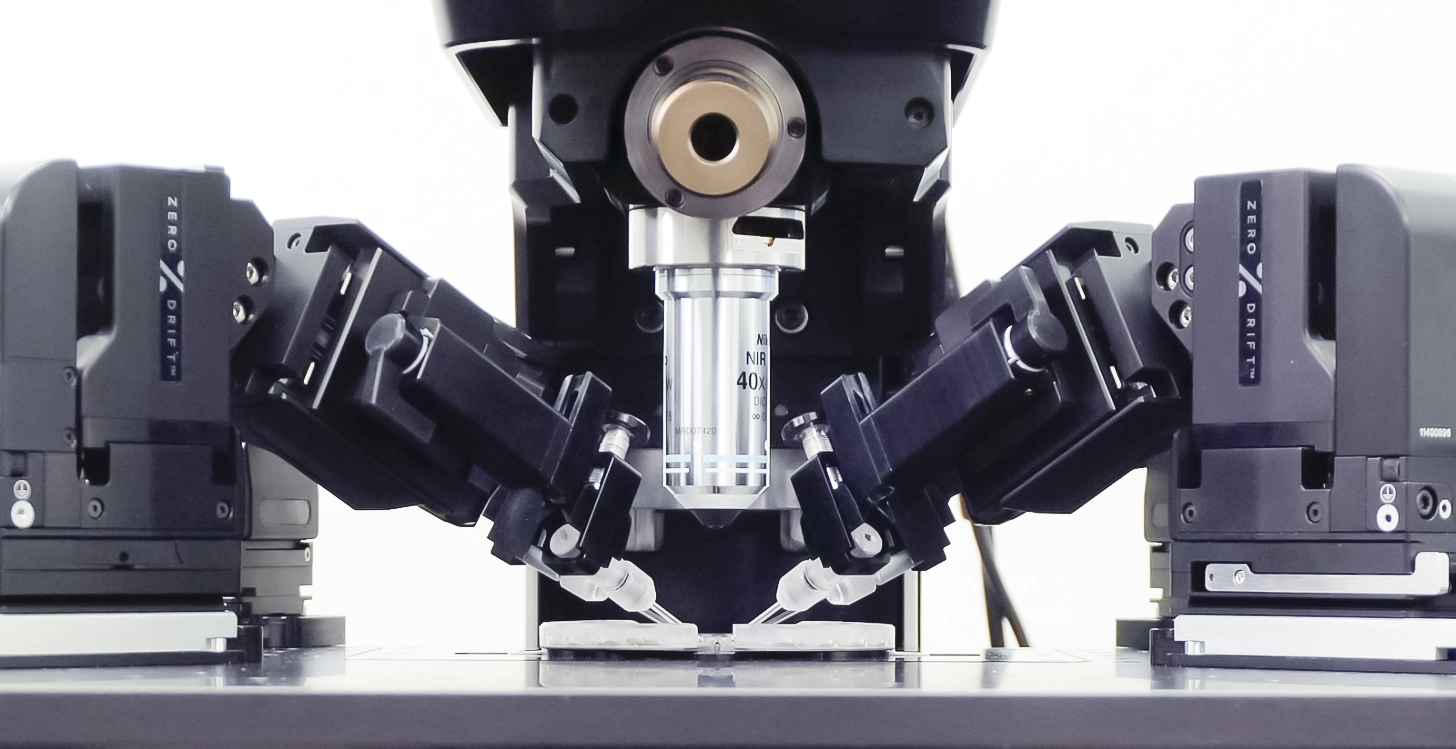
Zero drift is a defining performance feature in precision micromanipulation. Mechanical creep or thermal expansion in conventional stages leads to gradual positional errors, forcing the operator to constantly re-adjust during long experiments. In contrast, a true zero-drift system maintains stable positioning over hours, even at nm resolution, which is critical in applications where continuous stability is essential. Here we use two use cases to highlight our point:
Electrophysiology: Patch Clamp and Neuropixel Recordings
In electrophysiology, both patch clamp and neuropixel experiments demand absolute positional stability. Once a micropipette or probe is sealed onto a neuron, even a nm-scale drift can rupture the seal or shift the recording site. Zero-drift micromanipulators maintain electrode stability indefinitely, enabling long-term recordings without operator correction. This stability is particularly important in high-channel-count neuropixel probes, where drift would compromise simultaneous multi-site recordings.
Some examples of solutions we have supplied:
Sensapex micromanipulator suite incl microscope & controller: patch clamp, in-vivo neuropixel recordings & optogenetics
Intracytoplasmic Sperm Injection (ICSI – coming soon)
In IVF, ICSI procedures require delicate and repeatable penetration of the oocyte membrane using a microinjection pipette. Any drift after alignment risks damaging the cell or misplacing the injection. Zero-drift micromanipulators ensure the injection pipette remains precisely aligned with the oocyte throughout the procedure, providing reproducibility, reducing operator workload, and directly improving fertilization success rates.
Some examples of solutions we have:
Sensapex micromanipulator suite incl microscope & controller: patch clamp, in-vivo neuropixel recordings & optogenetics
High force-to-size ratio and holding strength for Z-axis motion of optical objectives
Objectives are often heavy optical assemblies that must be positioned with nm–level precision and held absolutely stable during imaging. PiezoLEGS® actuators provide exceptional force output in a compact form factor, enabling them to carry and move these loads without bulky mechanics. Unlike electromagnetic or screw-driven solutions, they maintain full holding force at rest without consuming power, preventing drift or sag even when the optical train is oriented vertically.
The combination of compactness, high force, and stable holding strength makes them ideal for objective positioning across multiple instrument classes. In digital pathology scanners, they deliver fast, precise focus adjustments across large tissue areas. In HCS and image cytometry systems, they support rapid autofocus and repeated Z-stacking without vibration or settling errors. In light-sheet microscopes, they stabilize high-NA objectives that must remain fixed while the stage moves. Even in electron microscopy, the same characteristics are essential for aperture and objective positioning inside high-vacuum columns.
Lab automation solutions: cost-effective, accurate, robust & compact multi-axis motion
Our customizable robotic stages are available in 1-, 2-, 3-, or 4-axis configurations, combining stepper-driven XY motion with an optional piezo-driven Z axis for sub-micron precision, forming the backbone of modern lab automation. These compact robots support applications such as plate handling, colony picking, sequencing workflows, PCR setup, and sample preparation, ensuring seamless integration into existing platforms.
Our XYZ stages provide fast, reliable motion that reduces cycle time while maintaining consistent low-µm level placement of microplates and labware. By automating plate movement across multiple deck positions, the stages improve walkaway time and reduce manual interventions.
In upstream and downstream workflows, such as PCR, NGS library prep, or high-throughput screening, the same compact platforms provide robust auxiliary motion for shuttling plates between devices, feeding liquid handling stations, or positioning labware for imaging and analysis. With payload capacities of 250 g – 500 g (0.55 – 1.1 lbs) and a very compact footprint as small as 215 mm x 250 mm (8.5 in x 9.8 in), they can be embedded directly into modular systems without consuming valuable deck space.
By combining cost-effectiveness, speed, accuracy, robustness, and flexible axis configurations, Acuvi’s robotic stages deliver scalable motion solutions that strengthen end-to-end liquid handling workflows and expand automation capabilities across the lab. end-to-end liquid handling workflows and expand automation capabilities across the lab.