Ten frequently asked question about Piezo LEGS®
1. What level of precision and repeatability can a PiezoLEGS® solution achieve?
Acuvi’s PiezoLEGS® motors are designed for sub-nanometer resolution with nanometer-level accuracy.
They excel in applications requiring ultra-fine incremental movement and high repeatability, making them ideal when stepper motors cannot meet the required accuracy.
Other solutions typically achieve micron-level precision, but may struggle with drift and repeatability over time due to mechanical backlash or thermal expansion.
2. How is position feedback handled?
Acuvi offers closed-loop control systems with integrated position feedback, ensuring precise and stable motion.
For example, PiezoLEGS® actuators can be paired with high-resolution encoders or external sensors for real-time error correction.
In other systems, position feedback is typically achieved with optical encoders or resolvers, but latency and resolution may limit performance compared to piezo-based solutions.
3. What is the achievable resolution and step size?
Acuvi’s Piezo LEGS® technology can move in sub-nanometer increments, with virtually infinite resolution since movement is friction-based and not limited to discrete steps.
Traditional stepper motors typically have step sizes in the few micron range, and while microstepping can improve this, it cannot match the continuous resolution of piezo technology.
4. How stable is the system over time and environmental conditions?
Acuvi’s motors provide drift-free positioning, maintaining their exact position without power, thanks to inherent self-locking.
This is particularly valuable for long-term experiments or when minimizing heat and vibration is critical.
Other motion systems typically require continuous power to hold position, which can introduce heat and mechanical creep over time, reducing stability.
5. What are the load capacity and force output?
Acuvi solutions can handle a wide range of forces, from delicate handling of optical components to pushing heavier loads depending on the actuator configuration.
Ball screw assemblies and linear stages can also be integrated for higher load-bearing capacity.
Conventional precision actuators typically balance precision and load, often forcing engineers to compromise between high resolution and high force.
6. What are the speed and bandwidth limits?
Acuvi’s PiezoLEGS® actuators are designed for precise, low to moderate speed applications, ideal for scanning, positioning, and fine adjustments.
Other high-speed motion systems, like servos, typically excel at moving quickly over larger distances but sacrifice precision and fine control.
7. Is the solution compatible with special environments?
Acuvi’s piezo solutions can be configured for vacuum, cleanroom, and non-magnetic environments, making them well-suited for scientific and medical instruments where contamination or electromagnetic interference must be minimized.
Other motion technologies typically require special adaptation for these environments and may not perform as well due to lubrication or material constraints.
8. How compact is the solution, and can it be integrated into my design?
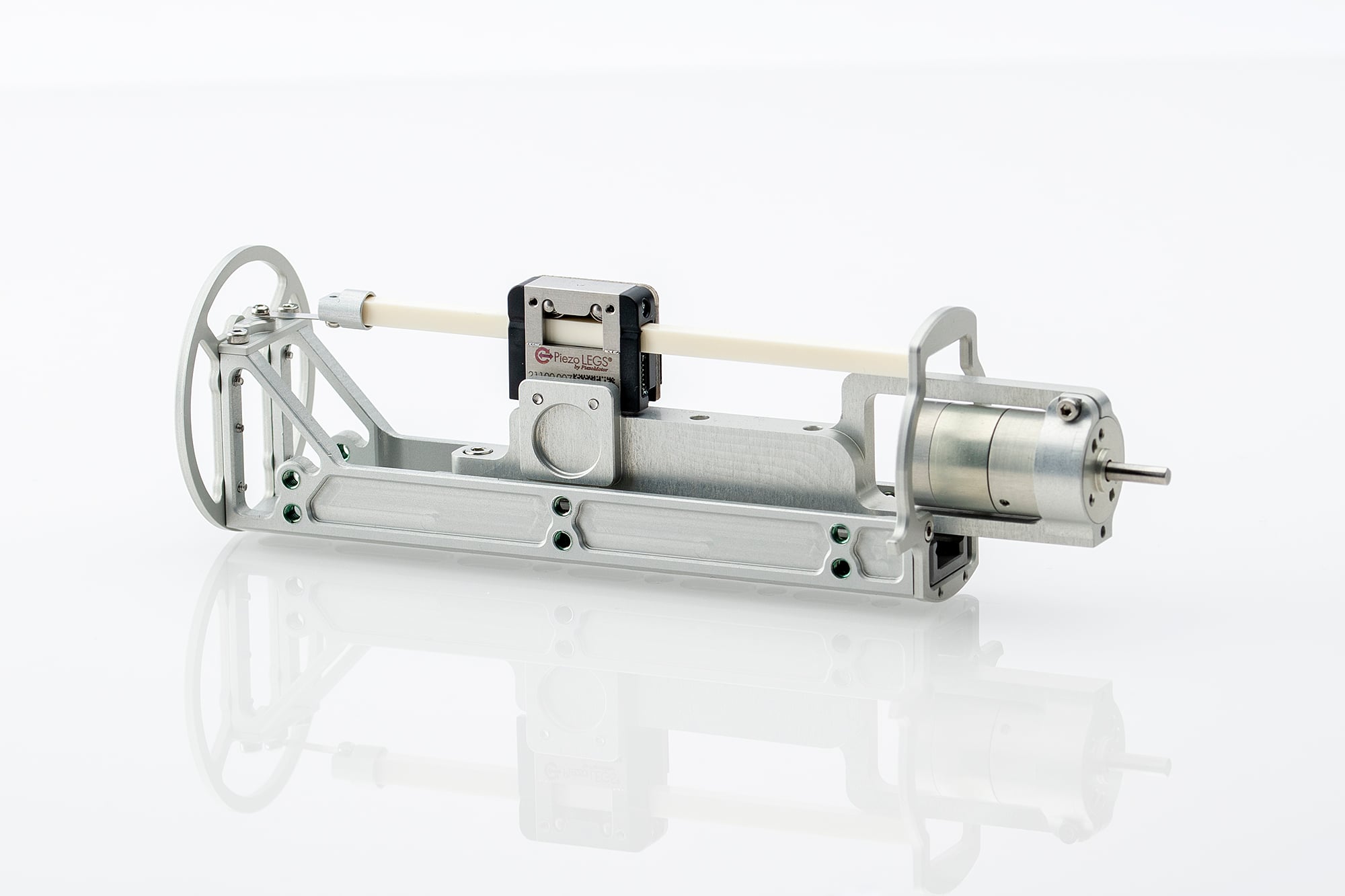
Acuvi’s actuators are compact and modular, allowing integration into tight spaces where conventional actuators would be too bulky.
This makes them ideal for handheld instruments, compact stages, or embedded motion systems.
Other precision solutions typically require larger footprints or additional support hardware, such as bearings and couplings, making integration more challenging.
9. What is the lifetime and reliability of the technology?
Acuvi’s PiezoLEGS® motors operate on a friction-based principle with minimal wear, delivering long lifetime and high reliability, especially when maintenance-free operation is required.
Other mechanical solutions typically require regular maintenance, such as lubrication or part replacement, due to mechanical wear over time.
10. What are the trade-offs compared to other motor technologies?
Compared to steppers, servos, and ultrasonic piezo motors:
PiezoLEGS® :
Ultra-high precision and stability
Self-locking, no power needed to hold position
Compact and cleanroom-friendly
Typical steppers and servos:
Higher speed and load capacity for long travel
Easier to control with standard electronics
Lower cost but limited in precision and stability
Precision Motion Comparison — PiezoLEGS® vs Typical Alternatives’
A quick reference for choosing a motion technology when steppers can’t deliver the required precision. Non-Piezo LEGS® columns describe typical characteristics; actual performance depends on configuration and integration.
| Criteria | Piezo LEGS® | Typical Stepper | Typical Servo | Typical Ball Screw |
| Precision | Nanometer-level; ultra-fine increments (application-dependent). | Typically, micron-level (with microstepping). | Typically, sub-micron with high-end encoder. | Typically, sub-micron with premium components. |
| Repeatability | Excellent; drift-free hold without power. | Typically moderate; risk of missed steps. | Typically good; depends on closed-loop tuning. | Typically good; depends on mechanical design. |
| Resolution | Continuous; sub-nm step capability. | Typically limited by step angle (e.g., 1.8°). | Typically high; encoder-defined. | Typically limited by screw pitch. |
| Holding Force / Stability | Self-locking; no power needed to hold position. | Typically requires power to hold. | Typically requires continuous power to hold. | Typically friction and mechanics provide hold. |
| Speed | Low–moderate; optimized for precision moves. | Typically moderate. | Typically high; rapid positioning over long travel. | Typically moderate. |
| Load Capacity | Moderate; can integrate with stages for higher loads. | Typically high (size-dependent). | Typically high; excellent for heavy loads. | Typically very high; heavy-duty mechanisms. |
| Environmental Compatibility | Options: vacuum, cleanroom, non-magnetic. | Typically lubrication limits sensitive environments. | Typically limited by heat and EMI. | Typically limited by lubrication and wear. |
| Size / Footprint | Compact; easy to embed in small systems. | Typically compact but deeper form factor. | Typically larger (motor + encoder package). | Typically larger; mechanical stack increases size. |
| Maintenance | Maintenance-free; minimal wear. | Typically bearings + lubrication required. | Typically motor/encoder upkeep required. | Typically regular lubrication and inspection. |
| Lifetime | Long life; low wear. | Typically good; bearing wear over time. | Typically good; environment-dependent. | Typically moderate; mechanical wear inevitable. |
| Cost | Specialized precision investment. | Typically low cost. | Typically moderate–high. | Typically moderate. |
| Best Use Case | Ultra-precise positioning; drift-free hold; compact systems. | Typically cost-sensitive basic positioning. | Typically fast, precise motion of heavy loads. | Typically high-force precision mechanisms. |
* Non-Piezo LEGS® columns describe typical characteristics of each technology class; actual performance varies by vendor, configuration, and integration.
Key Takeaways
When to choose PiezoLEGS®:
- When nanometer-level precision and drift-free stability are required.
- When space is limited, such as in handheld or compact instruments.
- When operation in vacuum, cleanroom, or non-magnetic environments is essential.
- When low maintenance and high reliability are priorities.
- When high force in small size is required
When stepper or servo motors are sufficient:
- When precision requirements are less demanding (e.g., micron-level accuracy).
- When high speed or heavy loads are more critical than ultra-high precision.
- When budget is a primary concern.
When to use ball screw assemblies:
- When very high load capacity and rigid mechanical structure are needed.
- In systems where precision is important, but environmental constraints are minimal.